
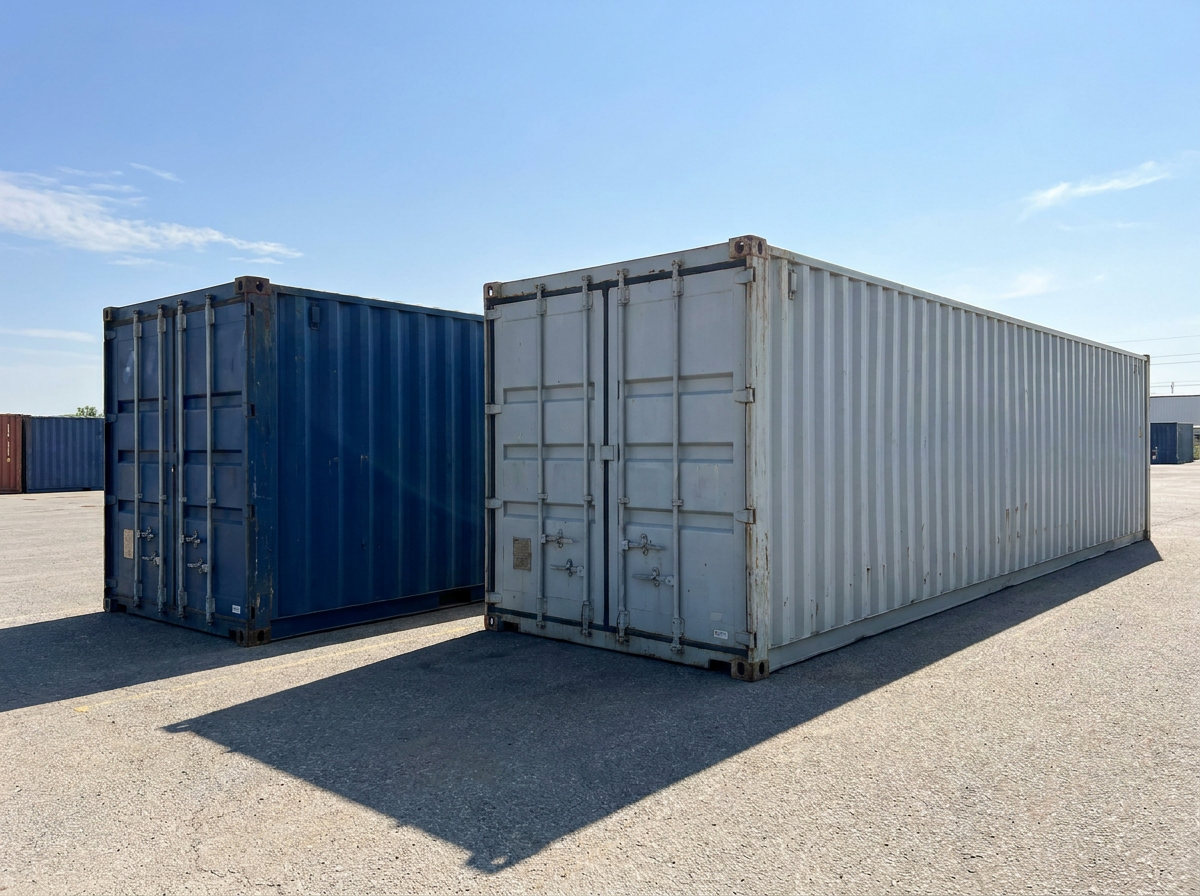
20ft vs 40ft Shipping Container: Which Size Wins?
The 20 vs 40 question has a clean answer once you look at three things: cost per square foot, delivery access, and what you’re actually storing. Let’s settle it.
The numbers
A 20ft gives you ~160 sq ft / 1,172 cu ft; a 40ft doubles that (~320 sq ft / 2,390 cu ft) for typically 40–60% more money — not double. On pure cost per cubic foot, the 40ft wins every time. Full specs in the dimensions guide.
Where the 20ft wins
- Access: needs ~60ft of straight run vs ~100ft for a 40ft — the deciding factor on residential lots.
- Placement flexibility: fits where a car parks; easier to screen from view.
- Relocation: cheaper and easier to move later.
- Weight spread: lighter footprint on marginal ground.
Where the 40ft wins
- Value: the cheapest space you can buy per cubic foot.
- Business storage: pallets, equipment, inventory — one 40ft beats two 20fts on price and walls.
- Conversions: offices and workshops want the length; high-cube 40s are the conversion standard.
The practical answer
Homeowners on normal lots: 20ft, almost always — access decides it. Farms, yards, businesses with room: 40ft for the economics. Genuinely torn? Measure your straight-line access first; the site usually answers before the budget does.
Measured your access? Pick your box.
20ft and 40ft, new and used, with live delivered prices — free shipping to all 50 states.


About author

About Author
Other posts byRelated posts
Shed or shipping container? Same mission — dry, lockable space in the yard — very different animals. Having sold thousands... Continue reading
Rent at $100–$250 a month, or buy a used 20ft outright? The math turns surprisingly fast — here’s the break-even,... Continue reading
Every June, Florida remembers hurricane season at the same time. The smart move is storage that’s already wind-rated before a... Continue reading
Used cargo trailers are where the deals live — and where the money pits hide. This is the 15-minute inspection... Continue reading
Enclosed or open? It’s the first fork in every trailer purchase, and the honest answer is: open wins on price... Continue reading
Add comment