
Trailer Weights & Towing Safety: GVWR Explained
Four numbers govern every safe tow. Learn them once and every trailer listing suddenly makes sense.
The four numbers
- GVWR — the trailer’s maximum legal weight, trailer + cargo. Set by the axles, frame and coupler.
- Curb (empty) weight — what the trailer weighs bare.
- Payload — GVWR minus empty weight: what you can actually load.
- Tongue weight — the downward force on your hitch: aim for 10–15% of loaded weight (gooseneck: 15–25% on the truck bed).
The math that keeps you legal
Loaded trailer weight must clear two limits: your vehicle’s tow rating and the hitch class. Example: a 7×16 enclosed at ~2,800 lb empty with 4,200 lb of cargo = 7,000 lb — half-ton-truck territory with a Class IV hitch, not an SUV job. When in doubt, weigh loaded at any CAT scale for $15.
Loading: 60/40 and low
Put ~60% of cargo weight in the front half of the deck, heavy items low and over the axles, and strap everything — shifting cargo changes tongue weight mid-drive, which is how sway starts. If the trailer fishtails: ease off the throttle (never brake hard), let it settle, then stop and re-balance the load.
Brakes, chains, lights
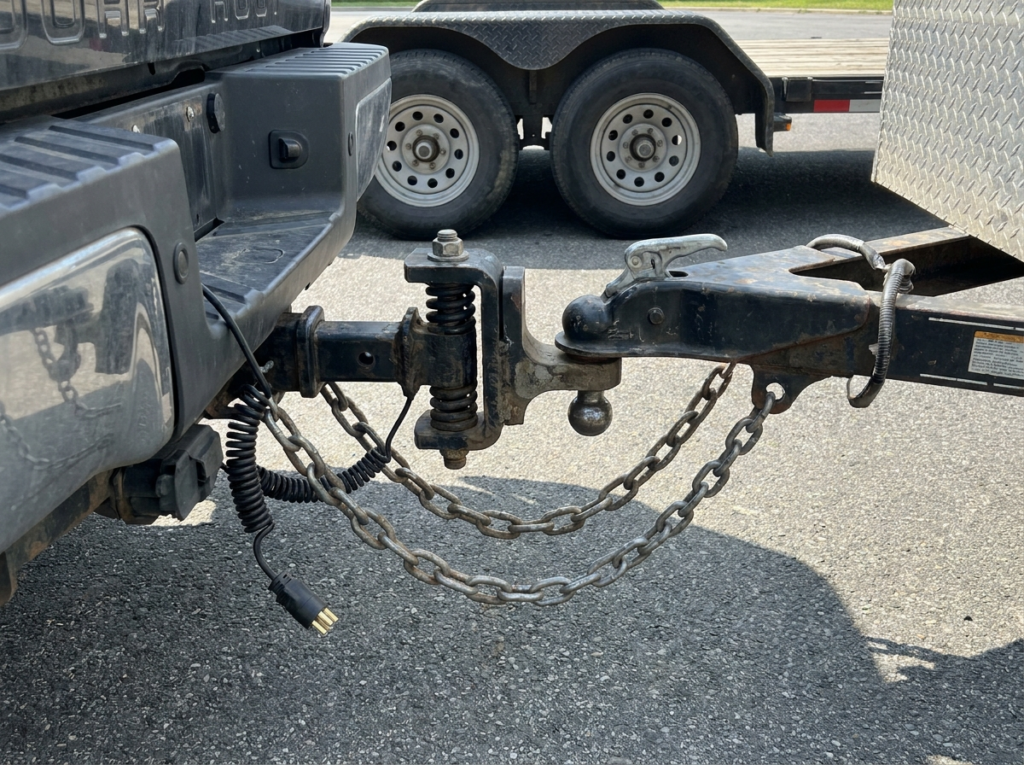
Most states require trailer brakes above 3,000 lb GVWR — tandem-axle trailers come with electric brakes; your truck needs a brake controller. Cross the safety chains under the coupler, and check lights every hitch-up. Full federal guidance: NHTSA towing safety.
FAQ
Can I exceed GVWR “a little”? No — it voids insurance, tickets in every state, and overloads brakes designed for the rating.
Do I need a special license? Not for typical consumer trailers; some states add requirements above 10K/26K combined — check yours.
Know your numbers? Pick your trailer.
Every listing shows the specs that matter — axles, GVWR, dimensions — with free delivery to all 50 states.